Why Use WordleFriend?
There are a number of Wordle solver and helper sites available, so why use Wordlefriend? The short answer: Wordlefriend will help you solve Wordle faster, but you still make all the decisions.
Why not use other Wordle assistance sites that are out there? The reasons that third party Wordle sites aren’t as good as Wordlefriend generally fall into two classes:
- General purpose word puzzle assistance sites. These aren’t tuned specifically to Wordle at all. This leads to many limitations, such as not matching up with the Wordle dictionary and having an interface that doesn’t accurately mimic the Wordle UI. As a result, this class of tools is inferior to most of the Wordle-specific tools.
- Wordle-specific sites. These are optimized specifically for Wordle but aren’t as highly optimized as WordleFriend. The main reasons for their limitations are summarized in the following table:
| Feature | Wordlefriend | Wordle-Specific Sites |
|---|---|---|
| Uses Regression Analysis | Yes | No (Entropy) |
| Over 3200 Wordle Solutions Identified | Yes | Unknown |
| Over 14,000 Guessable Words Supported | Yes | Unknown |
| Supports Past Tense Word Filtering | Yes | No |
| Past Answers Identified | Yes | No |
| Configurable | Yes | Some |
Why are these things important? Read on to see why.
Why Does Regression Analysis Matter?
After you have made your first guess you get some data back. If your starting word was CRANE (which is one of the words recommended by Wordle itself), you might get a result like this:

For this particular example, according to Wordlefriend, there are 110 possible answers left. In addition to these 110 possible answers, there are more than 14,000 words that you can use as guesses. The most highly optimized way to determine the next best guess would require testing all 14,000+ possible next guesses through multiple guesses for all 110 possible answers until the puzzle is solved for each possible answer, and then calculating what choices require the lowest number of guesses on average.
This approach, which is called regression analysis, takes a lot of computing power and can take 12 hours or more to calculate on a brand new high-end PC! It just doesn’t seem practical for most tools to apply.
All the advanced Wordle solver tools that we’ve analyzed (other than WordleFriend) use strategies based primarily on letter frequency and letter placement to estimate the next best guess. This concept is called entropy, it requires a lot less computing power to execute, and it’s a good second choice solution but it isn’t as powerful as regression analysis. Think of the difference as estimating the next best guess (using entropy) vs. calculating the next best guess (regression analysis).
As we noted before, performing a full regression analysis can take 12 hours to execute. Hard to imagine that anyone would want to wait that long for a suggestion as to the next word to guess! How has Wordlefriend solved that problem?
- Wordlefriend has precalculated all of the possible solution paths for the twenty most popular start words, plus nine others that are among the best possible starting words. These words make up 40% of the start words chosen by Wordle users on a daily basis (data from Wordle). This will help you choose the best word for your second guess in any Wordle puzzle. Want to know what the most popular start words for Wordle are? Here they are. Want to see the list of starting words for which Wordlefriend has precomputed next possible guesses using a full-on regression analysis? They can be found here.
- Once the total number of remaining possible answers gets below 65, Wordlefriend will perform full regression analyses on the fly to help you choose your next word.
- As a result, if your first two guesses get the remaining possible answers total below 65 words (which is highly likely) your entire game play will be powered by regression analysis from end to end instead of having to fall back to entropy.
This means that the great majority of the time all of your guess suggestions from WordleFriend will benefit from a complete regression analysis.
What if you prefer using a start word that isn’t in the list of words for which Wordlefriend has precomputed a full regression analysis? No problem! Wordlefriend will just use an entropy style analysis until your total remaining possible answers gets to 65 or lower. From there, WordleFriend will still perform a full regression analysis for you (the third party tools don’t do this either).
Over 3,200 Possible Answers Supported
It turns out that we can get the answer to that question from Wordle itself. Here is a screen shot from the New York Times Wordle Analysis site:

You can find this screen in the detailed analysis of your first guess. Note that the 3,209 solutions it references are before your first guess, so it represents the total Wordle dictionary size.
This is up significantly from the original Wordle dictionary which was only 2,315 words. The key factor is that the New York Times (the owner of Wordle) doesn’t publish the full list of words. Within Wordlefriend we have meticulously rebuilt our dictionary through comprehensive analysis of data provided by Wordle on a daily basis. Our dictionary stands at 3,209 words, so we have captured all of the words that have been added by the New York Times. To the best of our knowledge, no other tool has done that.
Over 14,000 Guessable Words Identified
According to the New York Times, Wordle accepts 14,855 words as possible guesses. As with the possible answers list, this list is also not formally published. You can find sites that purport to have the list online, but none of them (to our knowledge) have the exact list of all 14,855 guessable words used by Wordle. Wordlefriend has a list of 14,855 words that it allows as guessable words that we obtained from here. We don’t know that it’s exactly the same list as used by Wordle, but we have never had a guess word from our dictionary get rejected.
Past Tense Word Filtering
Our analysis shows that there are 209 past tense words in the Wordle dictionary. As of September 30th, 2026, none of them have ever been used as an answer by Wordle. While these words remain in the Wordle dictionary, they are identified as low confidence words. You can see this in the following screen shot, where the words ending in -ed are identified as having a <0.1% chance of being the answer. You can see all the -ED words in here marked with <0.1%.
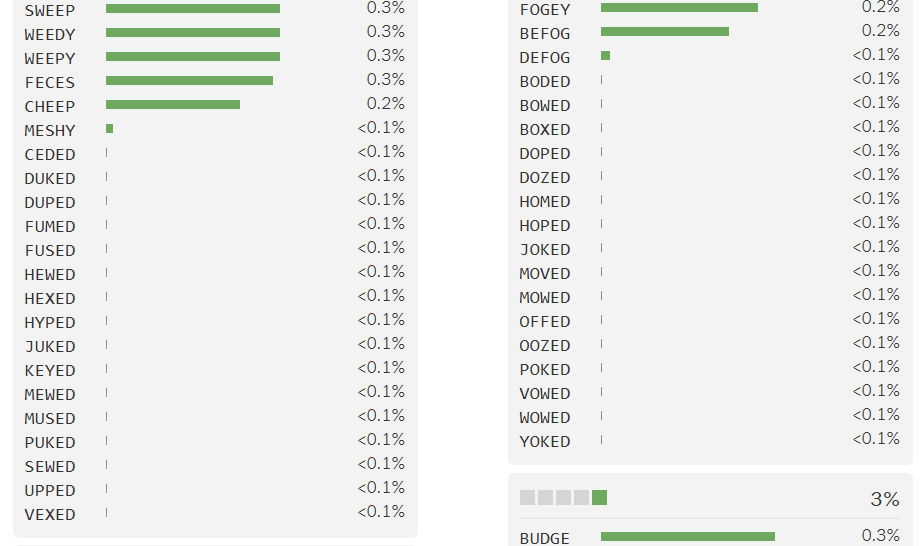
Will these words ever be used as an answer in the future? Our belief is probably not, but it’s not impossible, which is why we give you the option to handle -ed words however you want (include them as possible answers or not).
Identifying Past Answers
Initially, Wordle had a policy of never repeating the use of a word as an answer, but the New York Times changed that policy and began supporting reusing words as answers on February 2, 2026. This was a major change and with more than half the words in the Wordle dictionary already having been used as an answer in the past, you might guess that past answer words would be used again as answers half the time or more.
However, this is NOT the case. As of September 13, 2026, only 22 past answer words had been used as an answer a second time. This was over 203 days since February 2, 2026, which is a little less than 11% of the time. Therefore, it makes sense to prioritize selecting words that have never been used as answers before.
Wordlefriend supports this by identifying the status of each of the words that are remaining possible answers, enabling you to focus more on selecting possible answers that have never been used as an answer before as your next choice. Be careful though! Wordle does pick those repeat words about one in nine times.
Configure WordleFriend to Your Preferences
Wordlefriend lets you choose how recommendations are ranked. Please see the screen shot below to see all the available options.
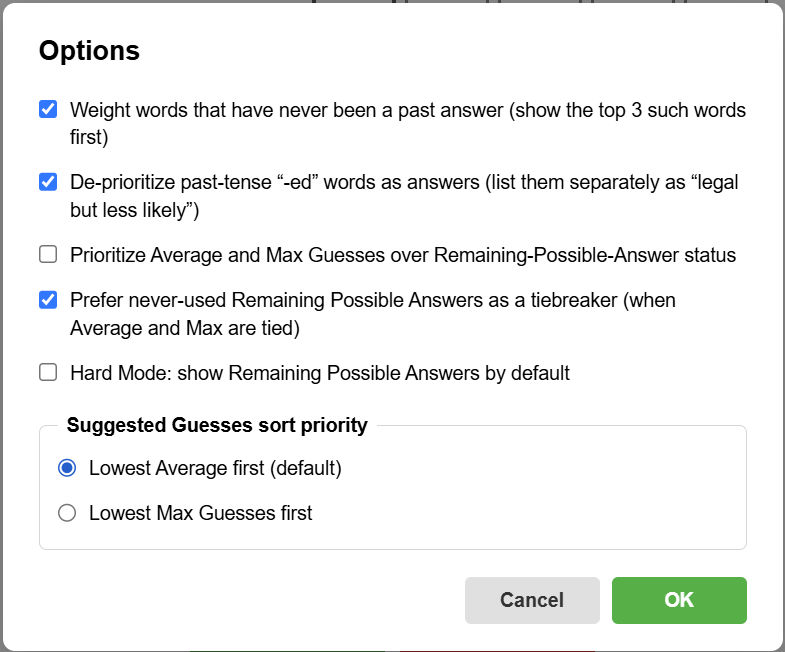
Here is a brief explanation of what each of the options does for you:
- Weight words that have never been a past answer (show the top 3 such words first) - causes Wordlefriend to show the top 3 words never previously used before as an answer at the top of the Suggested words list, regardless of Average and Max Guess scores. This makes it super-easy to see those words right at the top of the suggestions. However, they may be less efficient than other words, so make sure you look at the words below those top 3 before making your choice!
- De-prioritize past-tense “-ed” words as answers (list them separately as “legal but less likely”) - Since Wordle has historically never used past-tense words as answers, it makes sense to significantly lower the priority of those words.
- Prioritize Average and Max Guesses over Remaining-Possible-Answer status - A gentler version of the first option that doesn't forcibly move anything to the top of the list. It simply breaks exact ties in favor of a word that has never been a Wordle answer.
- Prefer never-used Remaining Possible Answers as a tiebreaker (when Average and Max are tied) - Since Wordle prefers words that haven’t been used as answers before, ensure those words show up in the Suggested Guesses list prior to past answer words when Average and Max Guesses are tied.
- Hard Mode: show Remaining Possible Answers by default - If you’re playing Wordle in Hard Mode, check this box.
- Suggested Guesses sort priority - You’re given two choices here: (1) Lowest Average First and (2) Lowest Max Guesses First. This simply allows you to decide what metric you want to place the highest priority on when sorting Suggested Guesses.
Let WordleFriend Help You Make Decisions
WordleFriend is designed to assist you, not replace your judgment.
There will be times when several recommended words are equally efficient. There will also be times when WordleFriend recommends a word that has already been used because it is mathematically a better guess than an unused possible answer.
In many cases, however, an unused possible answer may be the better choice, particularly when its average-guess score is close to that of other words that are suggested as guesses.
Remember: Wordle’s answer is ultimately picked by a human. Mathematical efficiency is not the same thing as predicting what the curator will choose.
Even if you don’t play in Hard Mode, it can be useful to look at the Hard Mode recommendations. They provide a good indication of which words remain possible answers. Just remember that the safest and fastest mathematical path to the solution isn’t necessarily a word that can itself be the answer.